Reframing ARTEMISIA GENTILESCHI, David with the head of Goliath, late 1630s
Posted: 30 Sep 2026 by
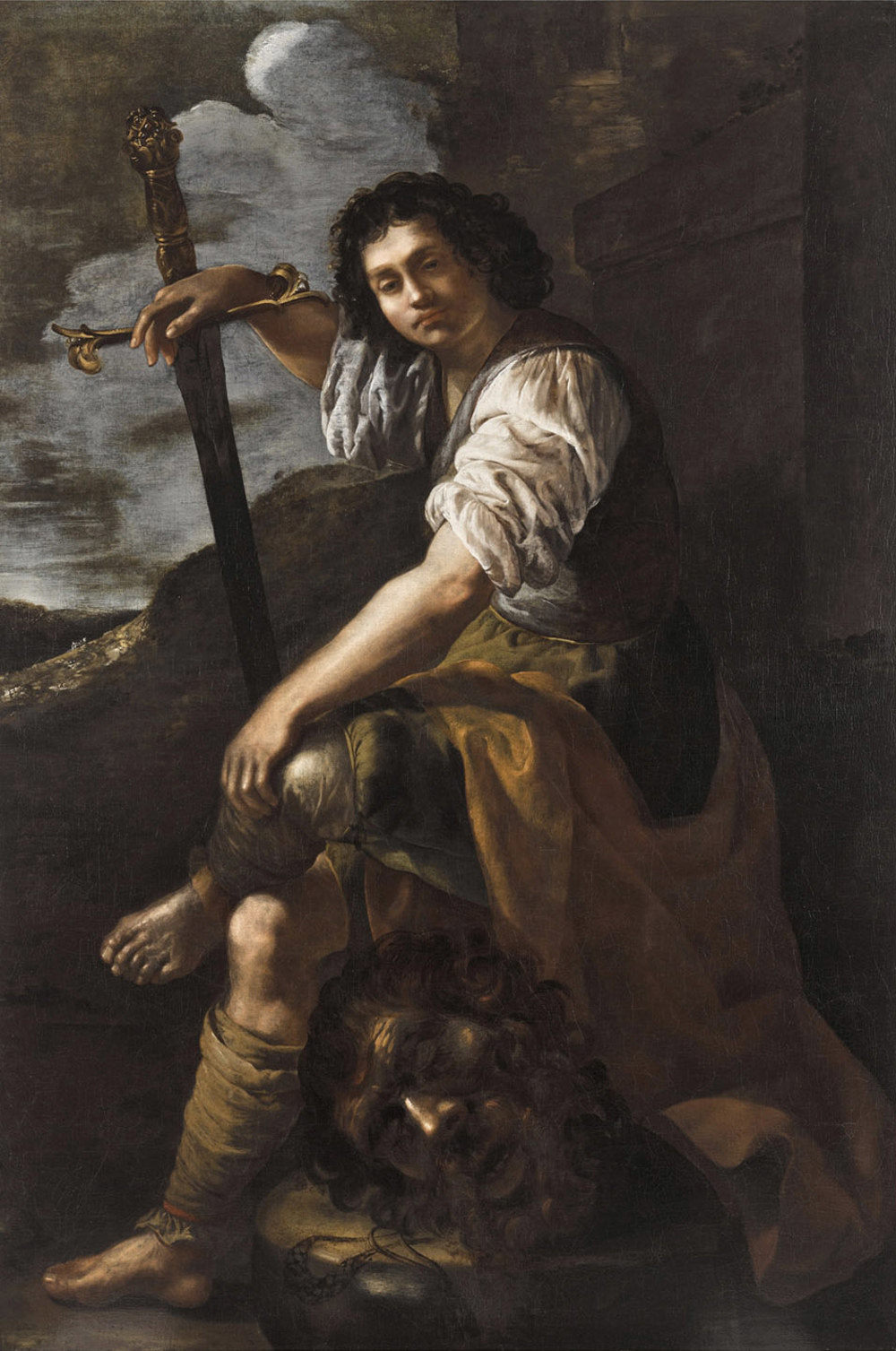
Artemisia Gentileschi (1593-post 1654), David with the head of Goliath, c. late 1630s, signed and partially dated, o/c, 202 x 137 cm
How do you frame a painting which may have been executed in 17th century London for Charles I, and returned here, to Sotheby's, in the reign of Charles III?
It has been lauded for the strength of its composition, the evocation of light and shade and colour harmonies, as well as for details such as the handling of the rolled-up shirt sleeves and the rich and massive sword, which holds the signature. This was uncovered by the conservator Simon Gillespie in the course of restoring the painting, allowing it to be offered by Sotheby's as an authentic autograph work.
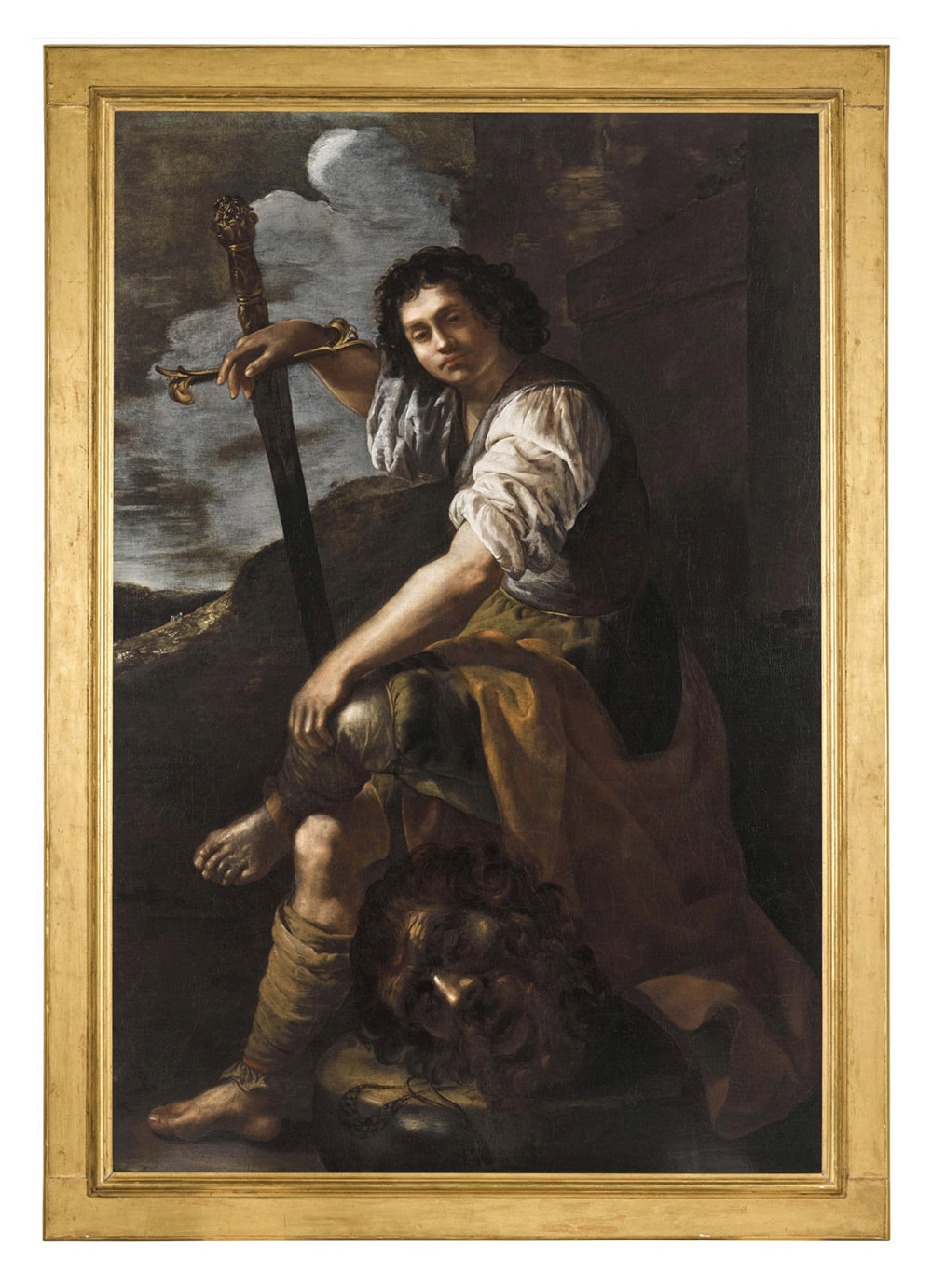
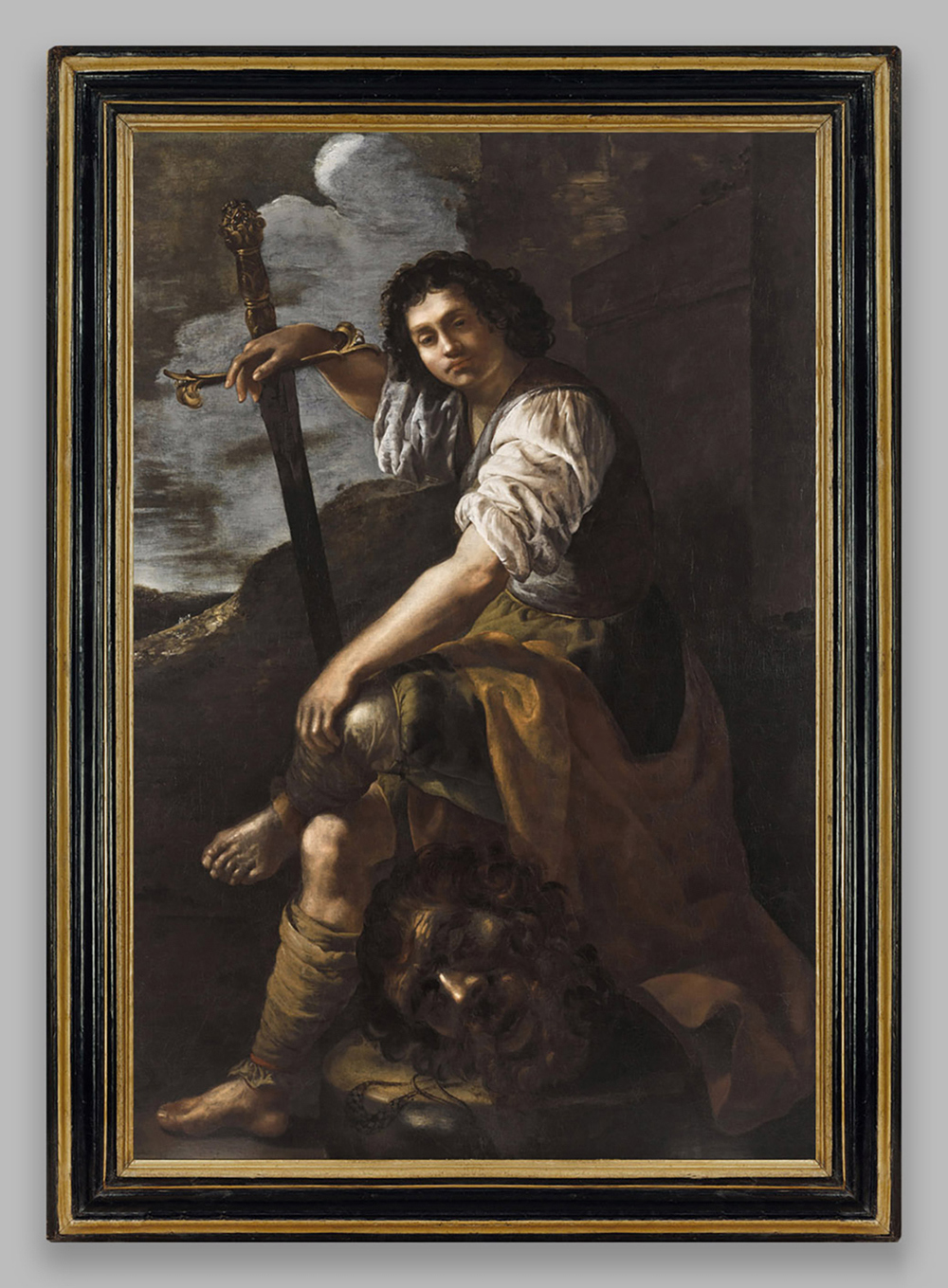
Gentileschi, David with the head of Goliath, in previous frame
It had been framed at some point in a very plain reverse architrave moulding, unornamented and gilded overall, which may have been in chosen in retrospective accord with the advice of Urban VIII's papal doctor, Giulio Mancini, to use giltwood frames for Caravaggesque works and black frames for brighter paintings [1]. However, this had resulted in an unremittingly stark and unmodulated presentation of the young shepherd-king. Mr Gillespie, the conservator, suggested that Paul Mitchell Ltd might reframe the painting much more happily, and a number of montages were produced which enhanced the Baroque theatricality of pose, colour and lighting.
[1] Giulio Mancini (1559-1630), Considerazioni sulla pittura, c.1619-21
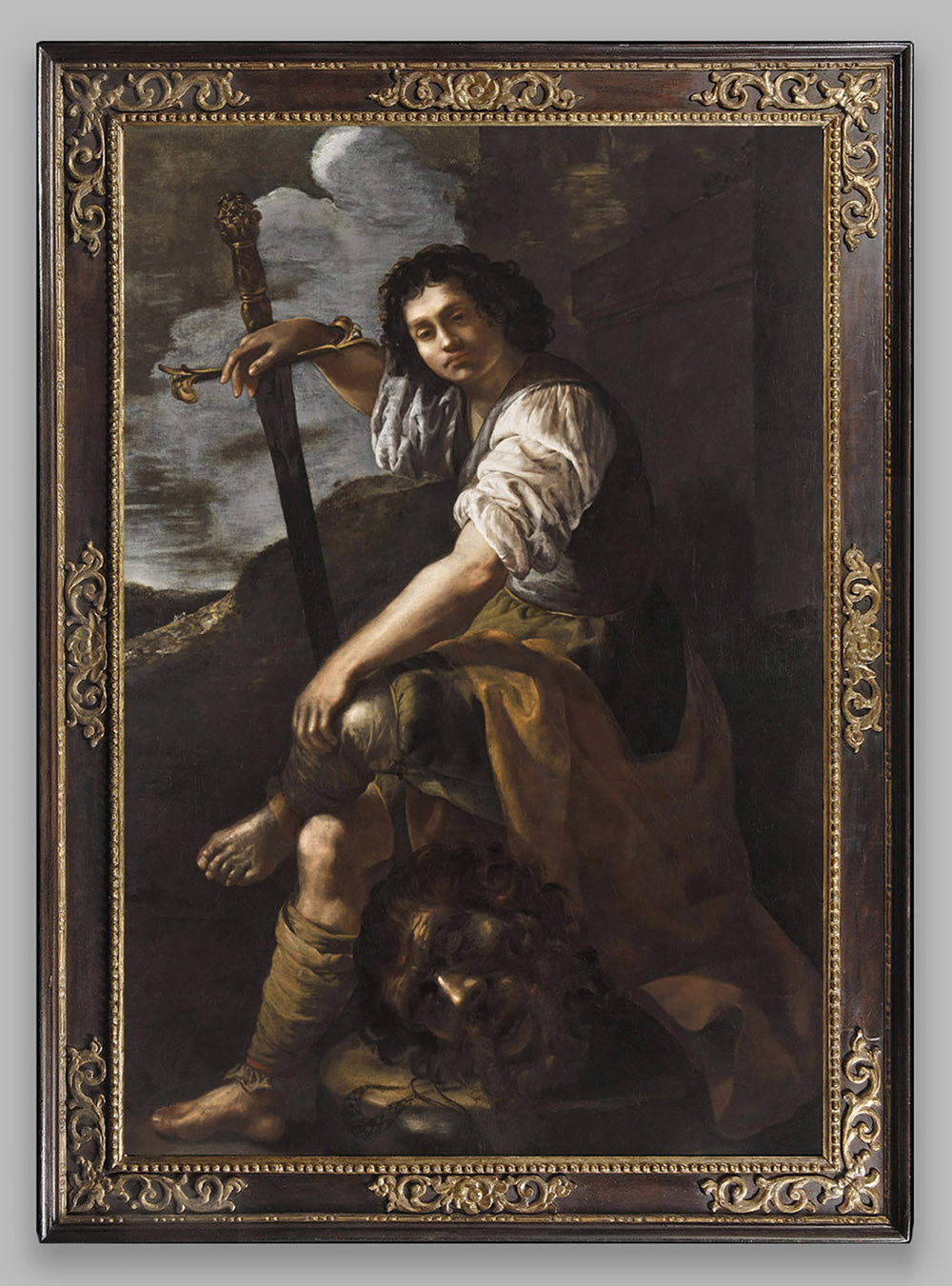
One of these was an example of a late Renaissance Roman cassetta made in the first quarter of the 17th century. It may seem stylistically too early a choice, but the cassetta is a very long-lasting form because of its adaptability to different genres and schools of painting, and it appears under various guises even up to the present day. This example is made of polished walnut, with parcel-gilt accents in the small mouldings which border the frieze, and in the carved, pierced and applied panels of scrolling foliate ornament which decorate it at corners and centres. Each rail is quite wide, so that - although the profile is flat, lacking the dynamism of the twisting, projecting figure - the frame adds to the authority of the presentation. It echoes and harmonizes with the palette of deep browns and blacks, whilst the gilding picks up the lighter tones of David's sword, flesh and robe, and the metallic highlights of Goliath's head. Beyond this, the gilded corner and centre ornaments help to hold and focus the viewer's attention on the painting, and may also indicate that this is the image, not only of the victor in a fight, but of a future king.
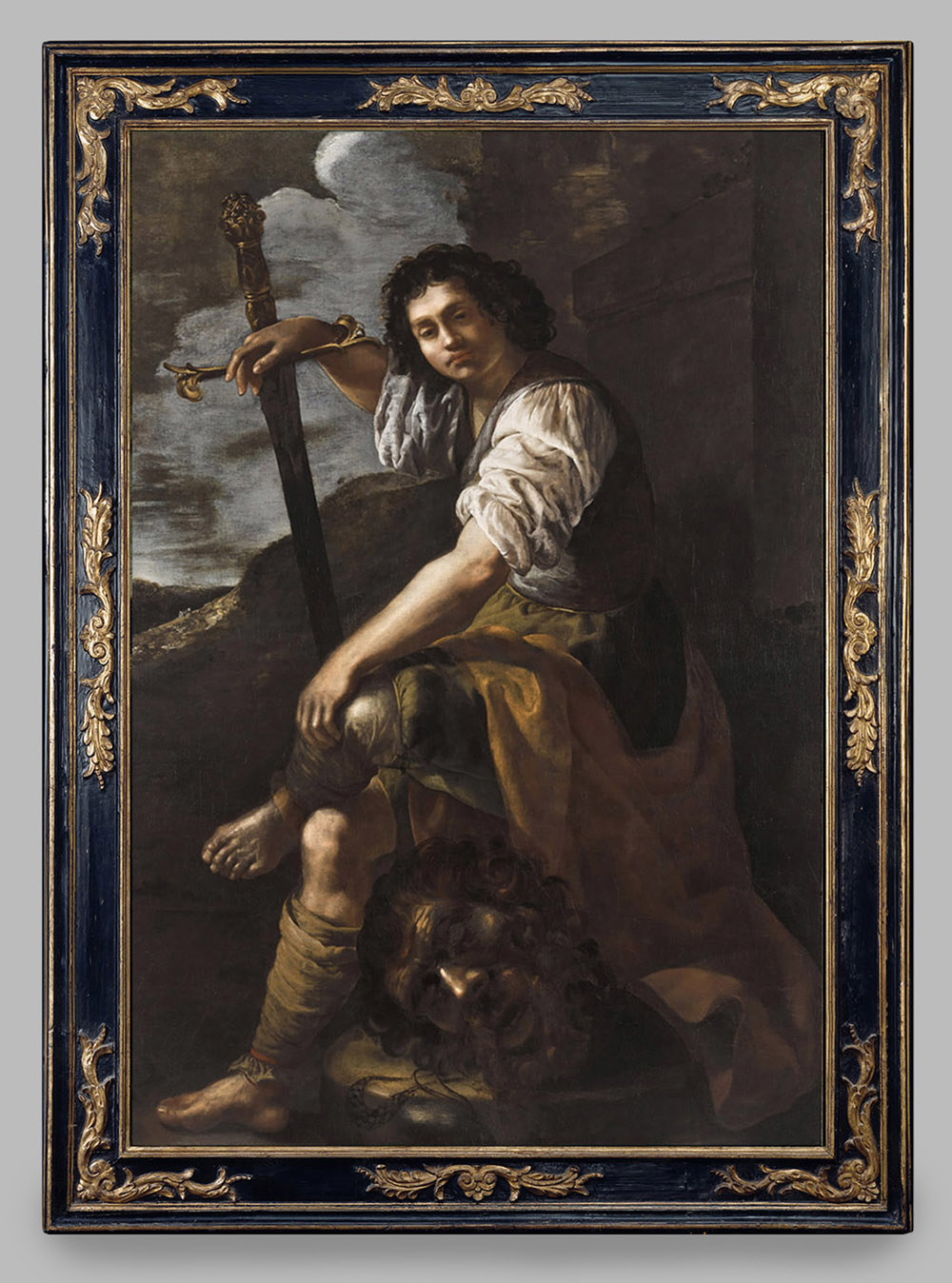
Another version of a 17th century cassetta with corner and centre accents - this time either Tuscan or Neapolitan - has a painted black ground rather than polished wood, with lines of plain gilded astragals defining the fields of the frame. The effect of the less decorative mouldings combined with the painted ground is to heighten the tenebrous cast of the whole work, and to enhance David's bleakly unyielding expression and pose. The foliate ornaments on the main frieze are drawn out into gently undulating leafy branches, but - rather than softening the contrast of black and gold - their form, which is curiously reminiscent of Zeus's thunderbolts, somehow adds to the apocalyptic atmosphere of David's victory.
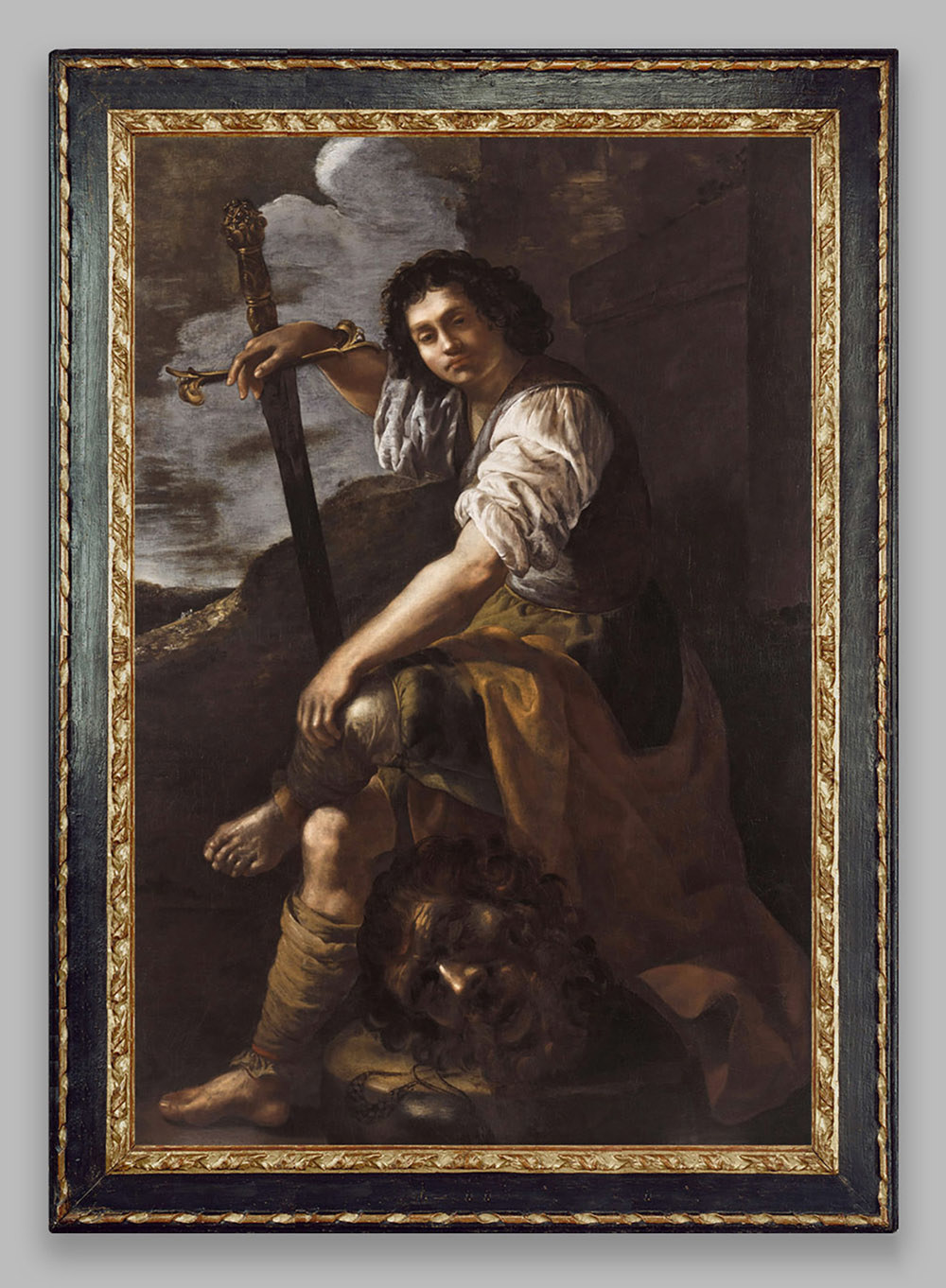
Another option was a reverse cassetta from Central Italy, also finished with black tempera and parcel-gilding, but here with the important torus moulding at the sight edge, rather than the outer contour. The shift in weight from back to inner edge gives a more Baroque feeling to both profile and structure; the carving of this torus at the sight edge into a decorative spiral leaf, emphatically centred so that the upper curled leaves run from the corners and point inwards, draws the eye inwards as well, and helps to increase the spatial depth of what is actually a very shallow painted space. The carved and gilded spiral ribbon at the back edge is also centred, and supports the movement of the spiral leaf moulding.
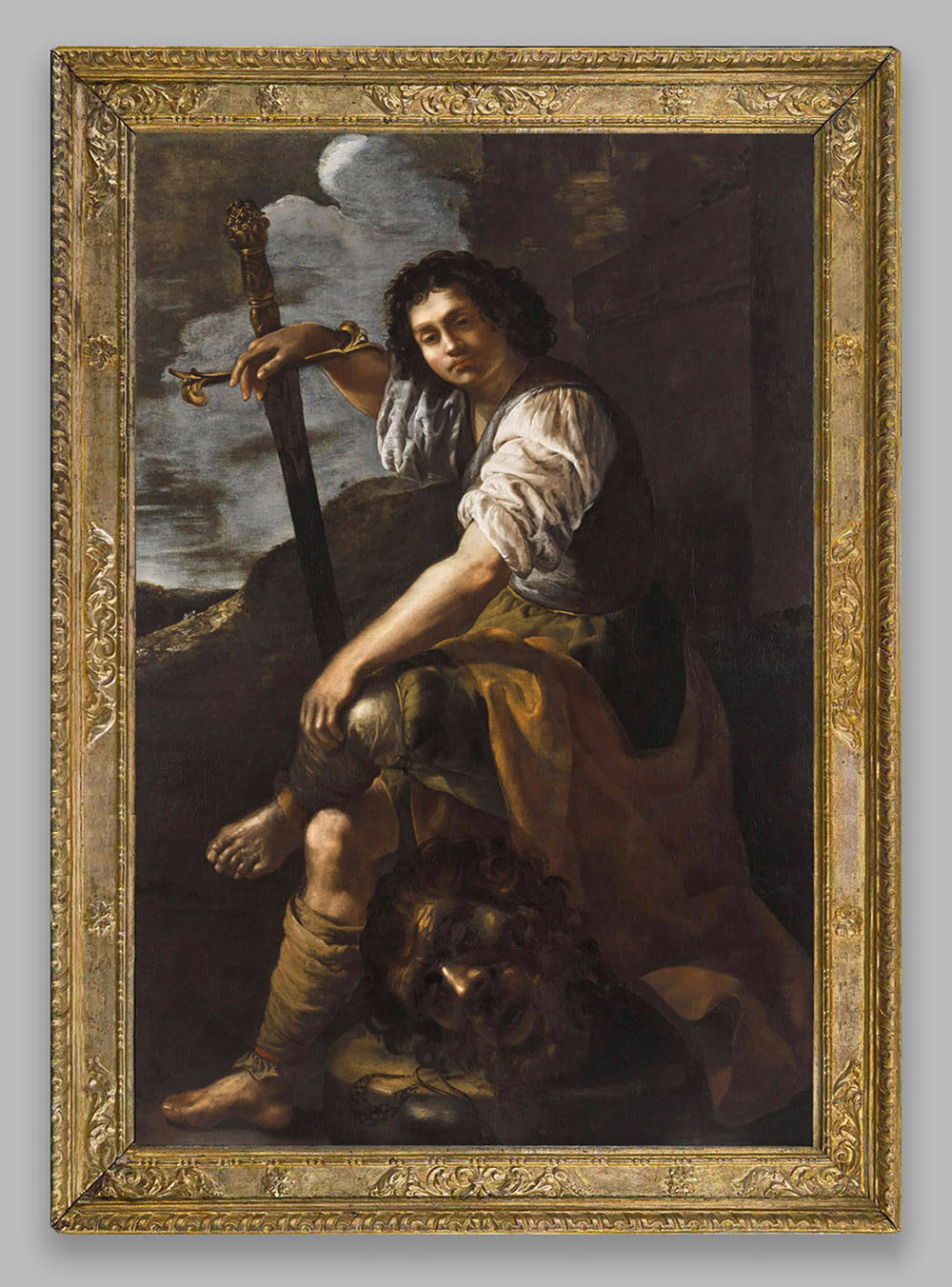
The finish of a rare cassetta from the first half of the 17th century is a feature of this choice; it has been covered with silverleaf, burnished, and then lacquered with a clear golden varnish, giving a slightly cooler tone to the frame, especially on the raised surfaces. This acts as an effective foil to the warm painted ochres, browns and flesh tones, whilst at the same time the 'gold' is darker and far more nuanced than the goldleaf of the previous frame. The frame is, again, delimited by two runs of moulding - an astragal-&-double bead at the sight edge, and a top edge with a raking form of stopped-channel fluting. This latter moulding is centred, like the spiral leaf and ribbon on the frame immediately above. The centring and raked ornament performs the same function here, although much more subtly - the flutes point inward, slightly emphasizing the perspectival pull into the painting.
The frieze is decorated, here, too, with tied scrolling foliage at centres and corners, and the demi-centres marked by rosettes. Because there is no contrast of ground and motif, however, this ornament provides a gentle shift of light and shade and texture, adding to the hint towards spatial depth in the composition.
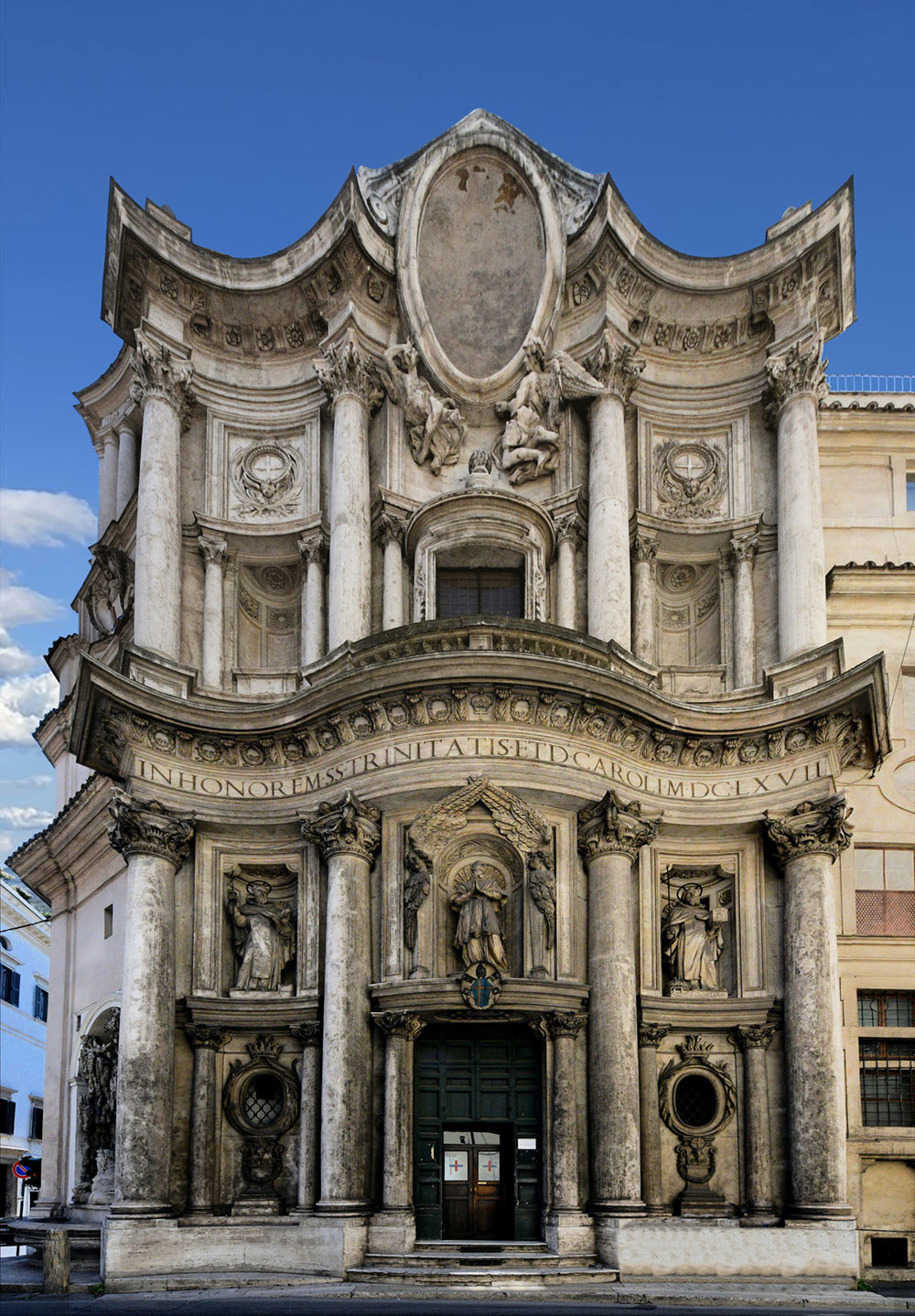
Francesco Borromini (1599-1667), façade of San Carlo alle Quattro Fontane, Rome, 16324-44, -80
Two more plain and unornamented black and parcel-gilt frames were suggested. These are not variations on a cassetta, or even a reverse cassetta, but true Baroque frames in which a play of concave, convex and flat mouldings, projecting forward or falling back, mirrors the foreshortening or recession of surfaces in Baroque architecture. The church of San Carlo alle Quattro Fontane, above, illustrates this play at work across the dancing curves of its façade, and the same play animates Artemisia's figure of David - apparently completely static, but simultaneously pushing arms and knees out through the picture plane and back across the containing wall behind him.
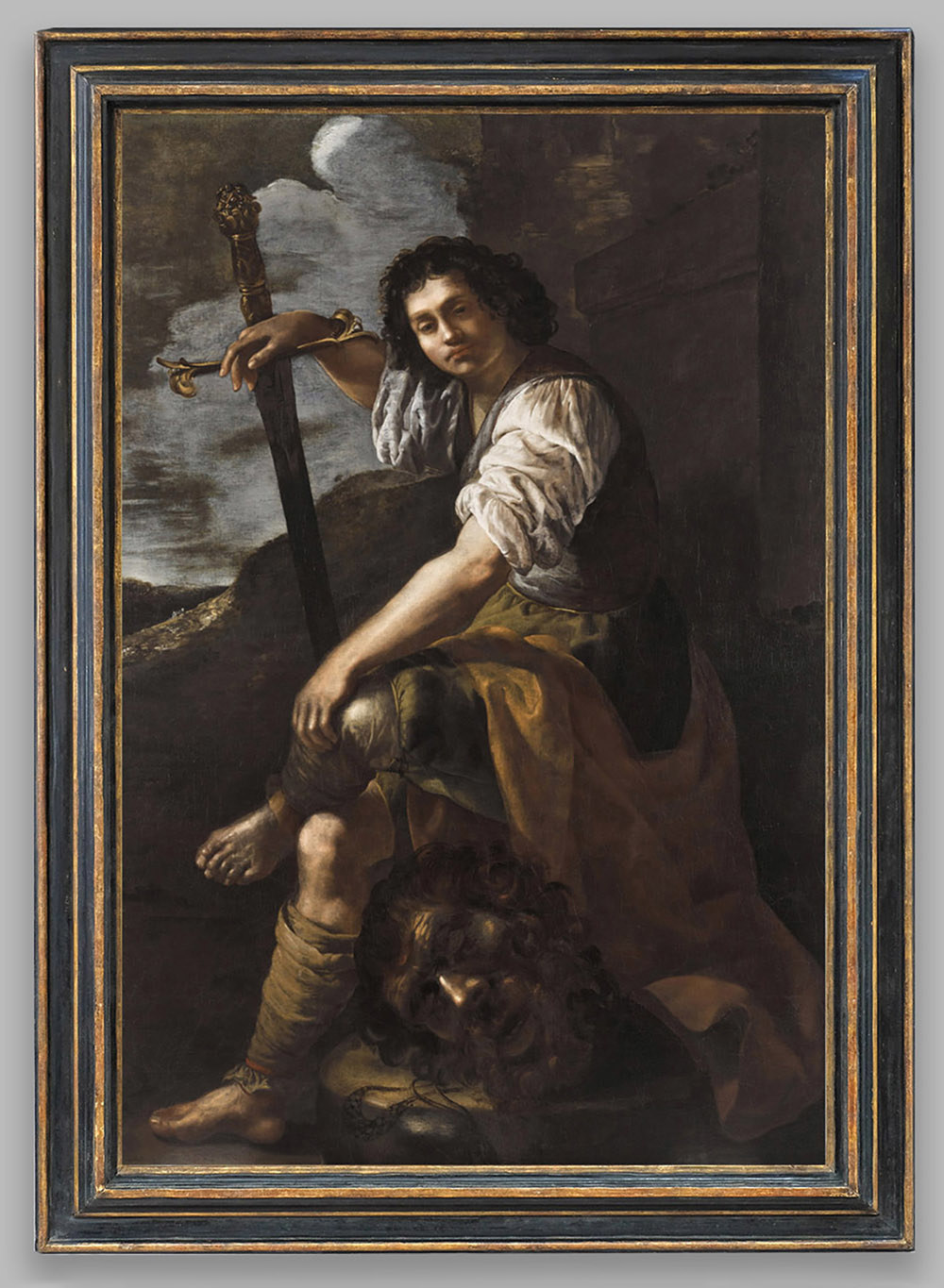
This frame, a Roman pattern from the first half of the 17th century, has a similarly complex and sculptural bolection profile, with a varied stepped top/sight edge formed of convex and ogee surfaces descending to the frieze at the back. It is finished in black tempera, picked out with parcel-gilded astragals and a top fillet, which echo and harmonize with the dark tones and muted ochres of the painting.
A contemporary and rare Tuscan frame with an even more complex compound bolection profile, this mimicks the plasticity of Borromini's work on a miniature scale, and demonstrates how innovations in architecture could influence every type of object which filled the interiors of avant-garde buildings; and how, at the same time, they influenced or were influenced by current techniques in art.
The cassetta designs of the 15th and 16th centuries were tied to the classical geometry of Renaissance buildings, sculpture and painting - balanced, symmetrical and graceful, reflecting theories of celestial harmonies as they seemed at that time to be mirrored in the movement of stars, the structure of contemporary music, and even the symmetry of the human body. The frames of the Baroque period are altogether more theatrical, dynamic and restless - in their profiles, where the mouldings swoop in and out, and accrete in a choreography of ogees, toruses and hollows, and in their use of ornament - often multiple, and using the variation of profile to express the shapes of plants, animals and exaggerated architectural motifs. Even where a cassetta form was used (as in the 17th century designs above), these were more substantial, the mouldings projected more emphatically, and were allied to more robust ornament. In all these developments, as already suggested, the carvers and gilders of the 17th century were following exactly the same path as the painters who came to them for designs which echoed the lines, forms and volumes of their own work.
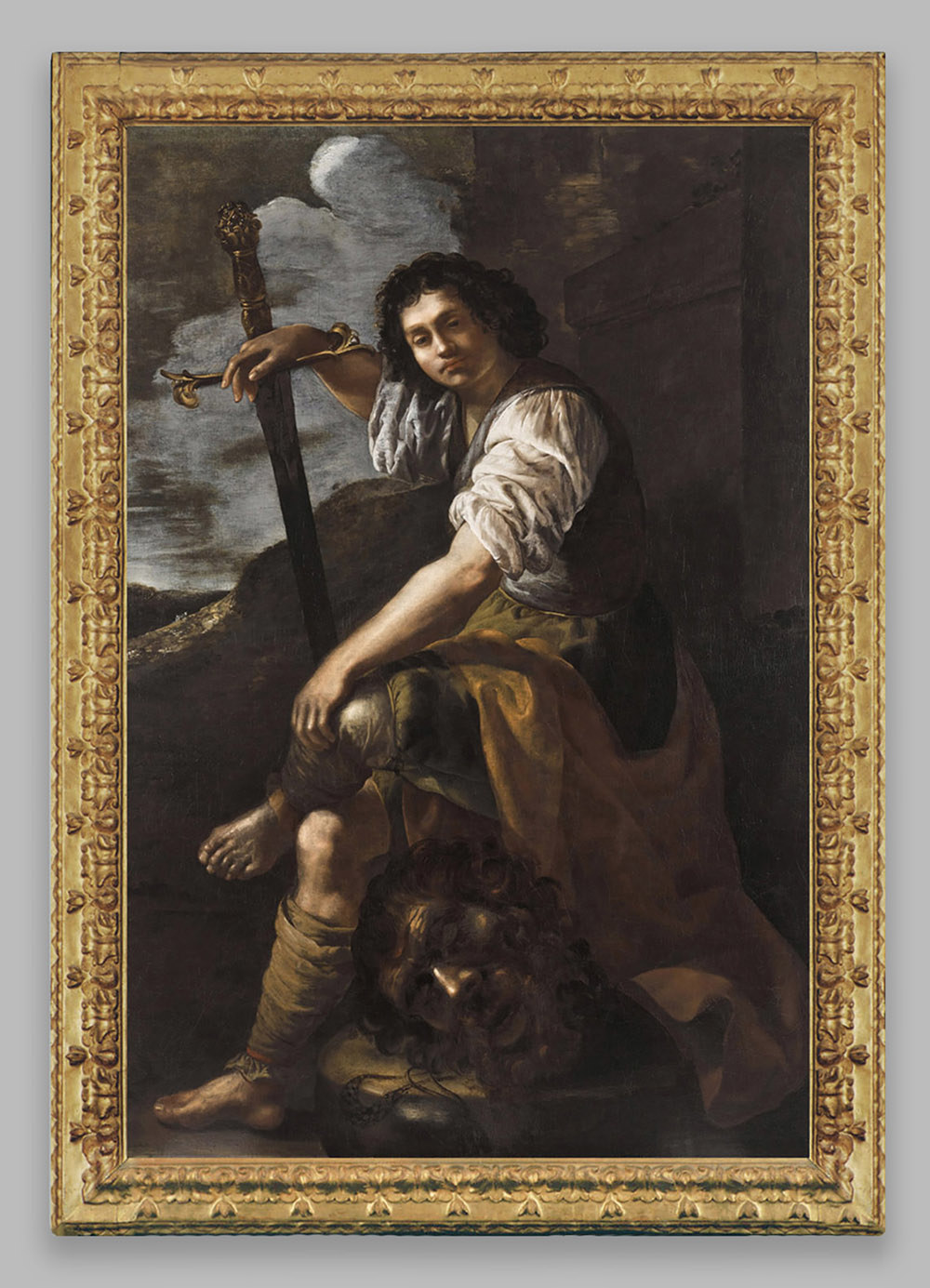
The frame which was finally chosen for Artemisia's David with the head of Goliath is thoroughly Baroque in its bolection profile and interlocking curves, and its mouldings are decorated with the organic ornament which is as important to this style as any dramatic forms and images. It has an ogee at the back edge with a leaf-&-dart moulding rising to a central frieze, which supports the main, important moulding of a large ogee, curling over into a projecting torus moulding. This typically Baroque profile is functional as well as decorative, pushing the picture plane out from the wall, towards the viewer, and asserting its presence amongst the distractions of what would have been its original setting - full of the competing colours, textures and images of the 17th century interior.
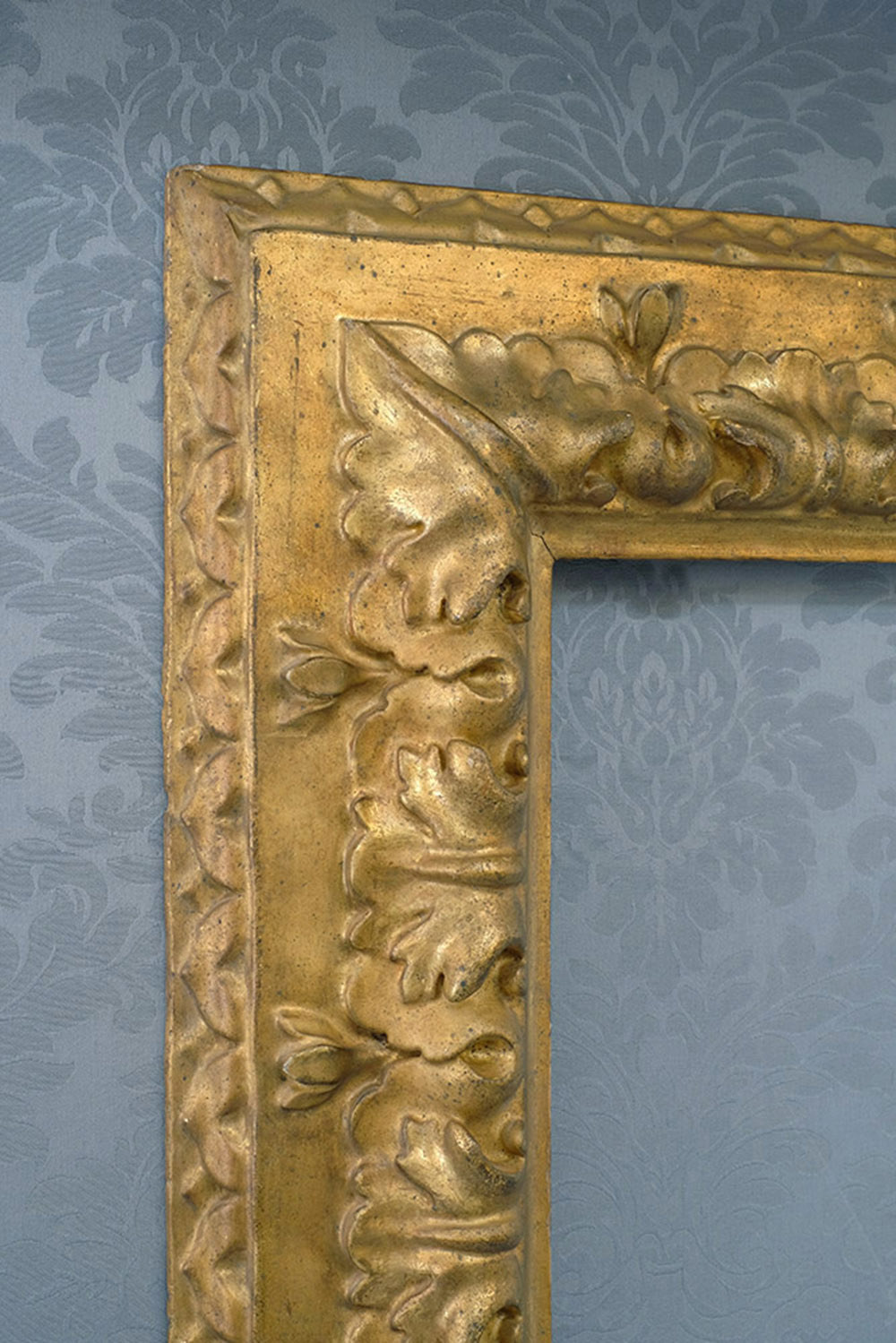
Detail of chosen frame
The top moulding is carved with a large acanthus leaf, which falls naturally over the ogee; instead of the usual acanthus-&-dart or acanthus-&-shield ornament, however, the leaf alternates with a small tulip-shaped bud, which grows across the frieze, punctuating its plane in a regular rhythm. Like the broken surfaces of the leaves, this is a light-catching element which helps to animate the painting itself. The client also preferred the overall gilding, which uses both matte and burnished finishes, and which echoes the golden hilt of David's sword, with its plant-like forms. The gilding gives symbolic expression to David's heroic status, after the conquest of the gigantic Philistine, Goliath, and looks forward to his later rôle as king.
This is a very rare antique frame, dating from the early 17th century and originating in central Italy. It was unfortunately slightly too small, at 194.3 x 120.7 cm., for a painting 202 by 137 cm., so a faithful replica was offered. This was carved by Nigel Hilliard and finished by his brother Michael - descendants of the Huguenot carvers and gilders who had sought sanctuary in England and Ireland after the Revocation of the Edict of Nantes in 1685 threatened the careers, families and lives of Protestants living in France, and whose skills made a significant difference to the techniques of framemakers in the British Isles.
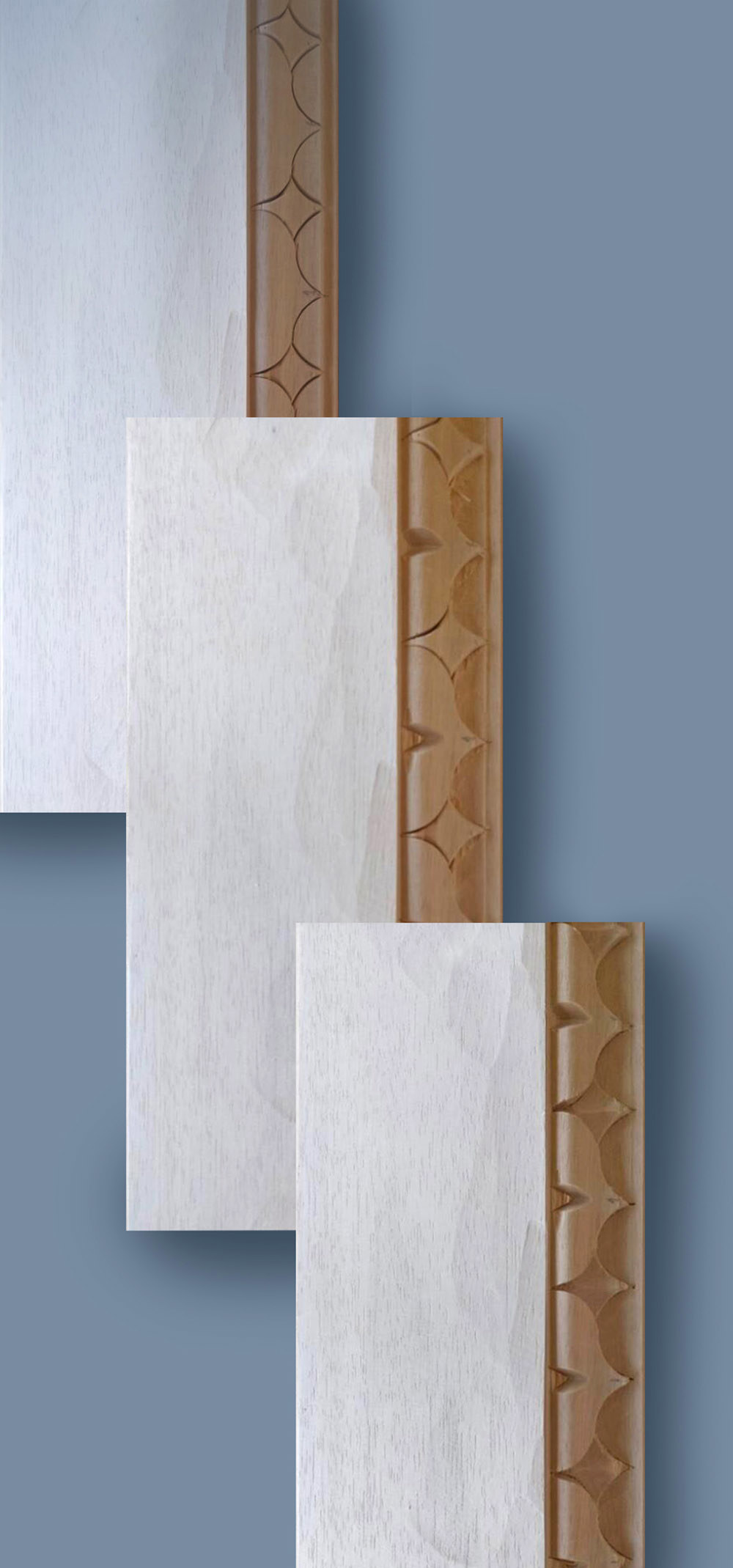
Stages of carving the leaf-&-dart on the back edge of the frame
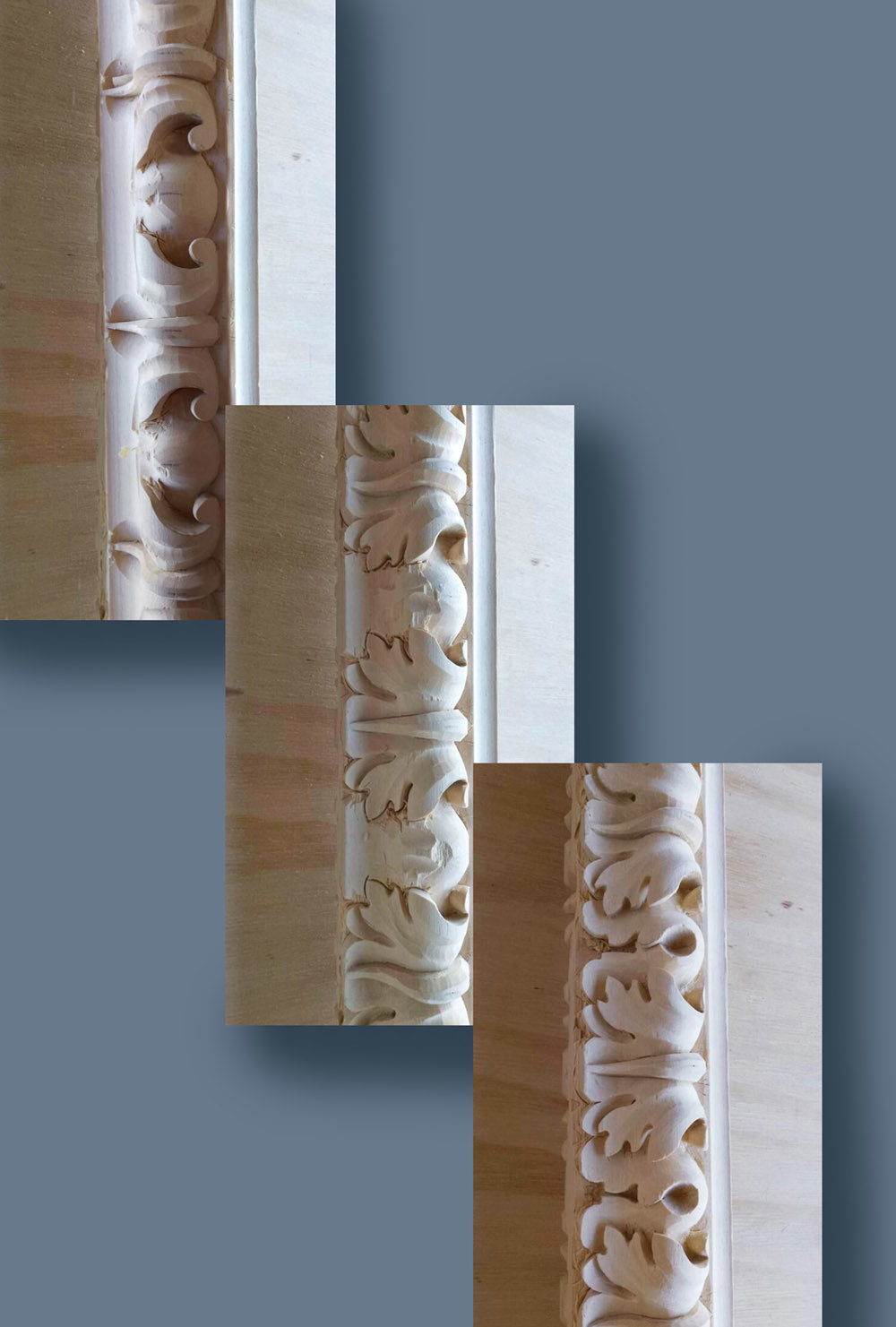
Stages of carving the acanthus leaf on the top edge of the frame
The ornament was designed with pin-point care to fit the lengths of each specific moulding from corner to corner, and then carved with sharply-defined edges, to allow for the later layers of gesso which veil and soften the carved wood, and provide a bed for the gilding.
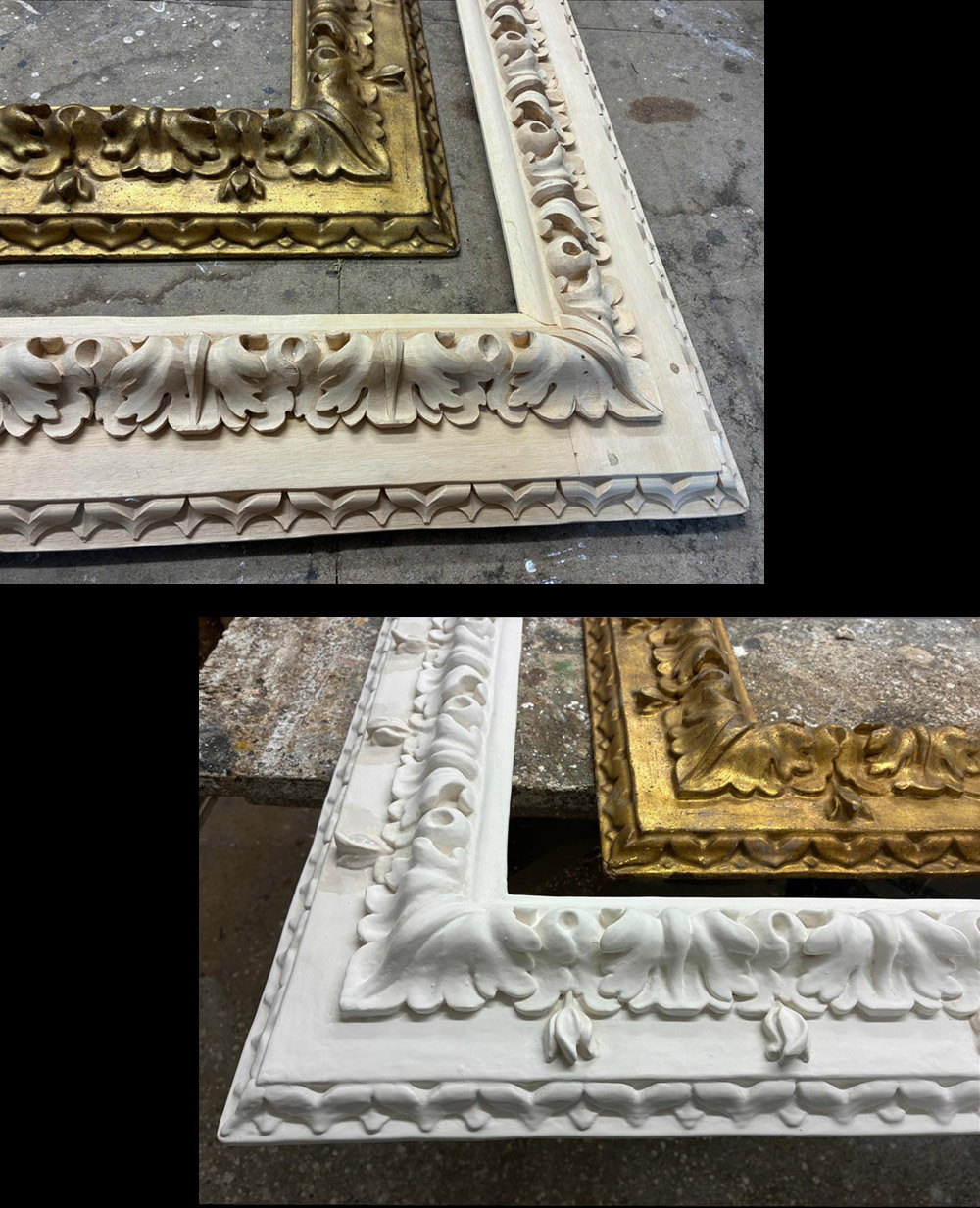
Stages of assembled frame: upper image shows a corner of the whole frame compared with a finished corner sample; lower image shows the tulip-shaped buds carved and applied along the frieze, and the whole frame gessoed prior to gilding: again shown with a finished corner sample
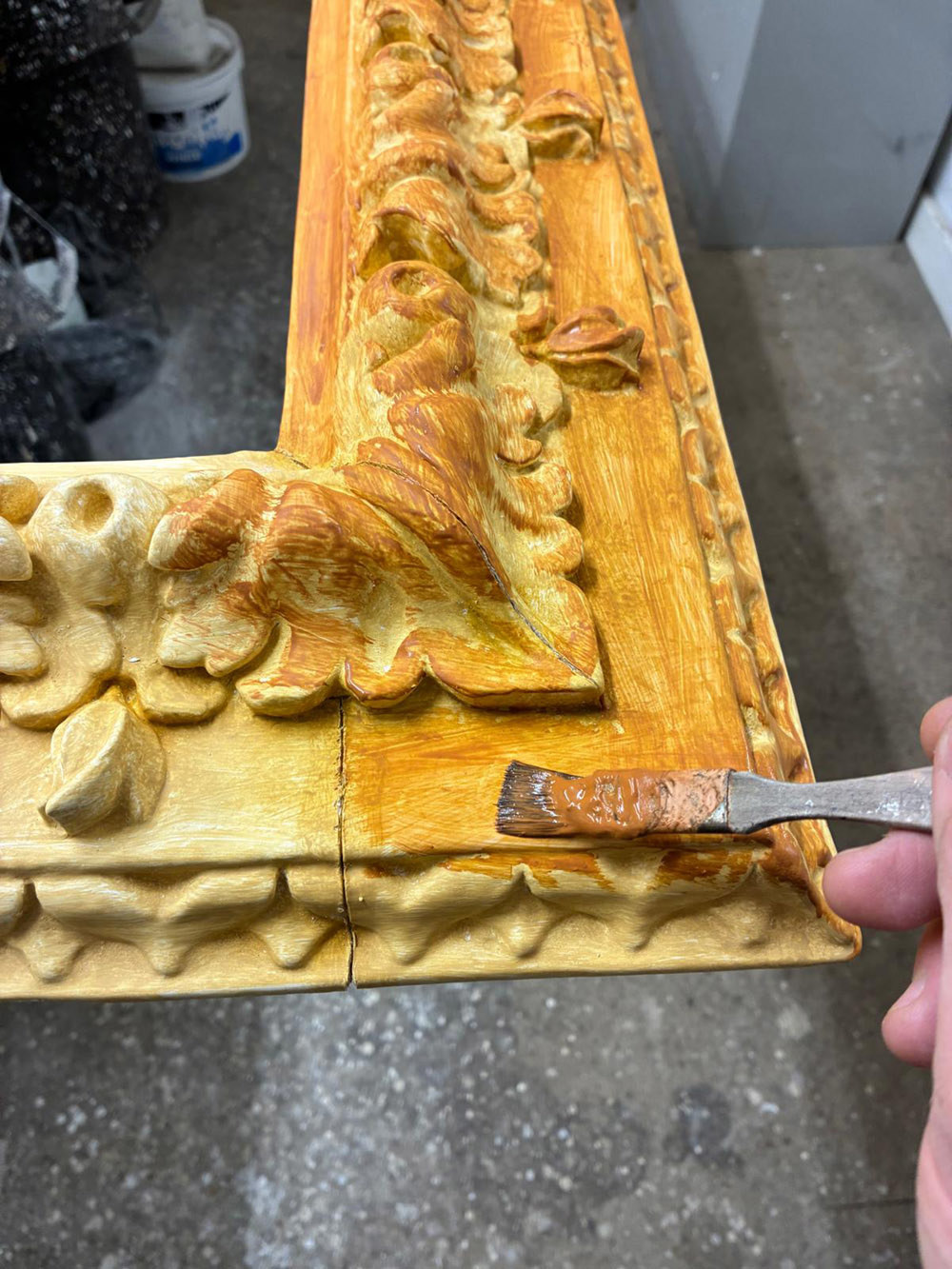
Applying the coloured bole (gilder's clay) on the layers of gesso
The carved wooden frame is assembled, and coated with several layers of liquid gesso, each of which is allowed to dry thoroughly before being rubbed down to a satin-like finish. After this, a coat of coloured gilder's clay or bole is brushed on: this is the final layer, to which the gold leaf will be adhered.
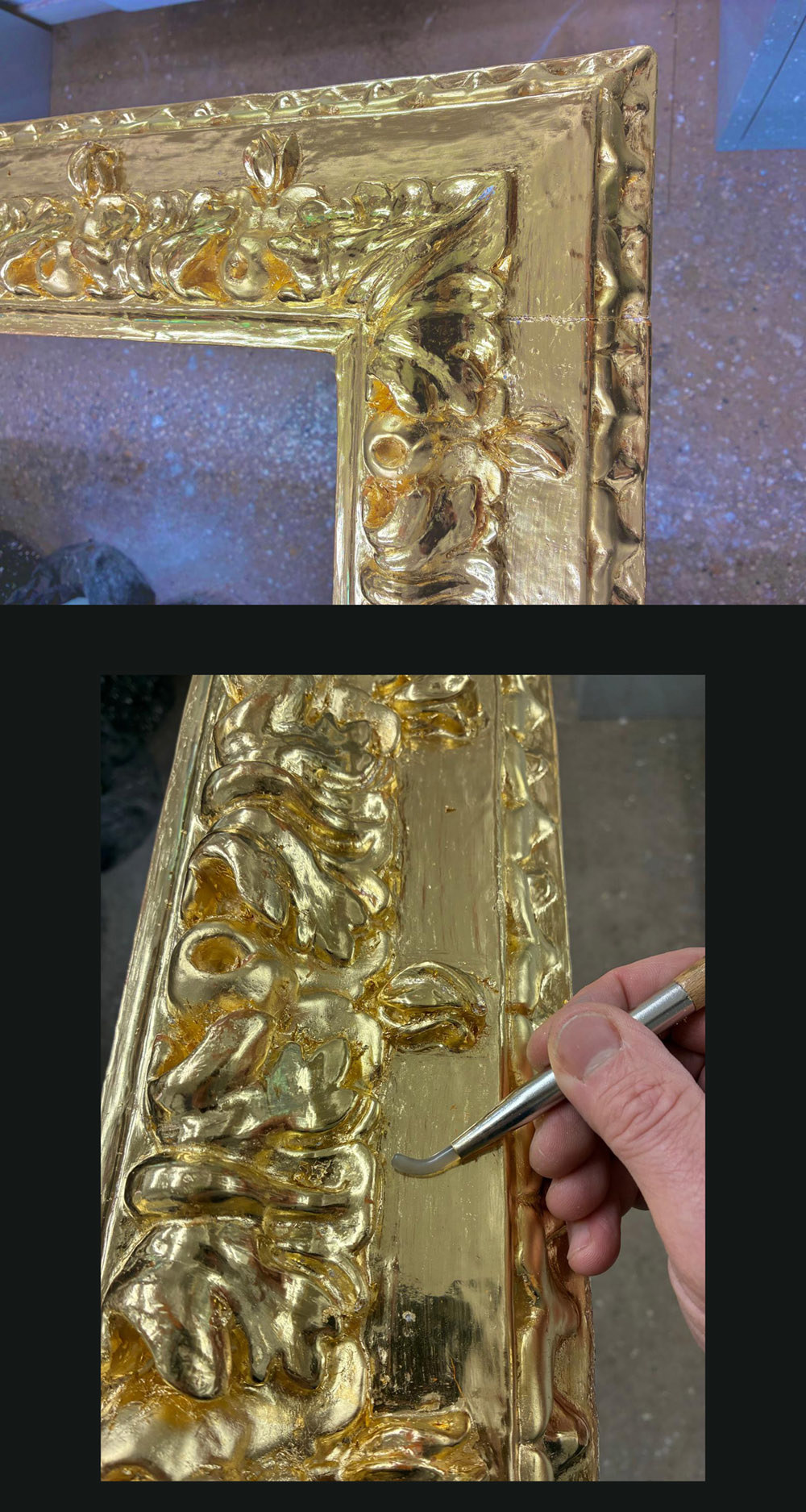
Gilding the frame and burnishing the gold
The bole is moistened, and the square leaves of gold transferred to it with a broad, flat brush - the gilder's tip - which holds each leaf by means of the static electricity present in clothes and hair. When the whole surface is tiled with overlapping leaves, the gilder burnishes them with a rounded piece of agate (or, historically, an animal's tooth), which presses the gold into the crevices of the ornament, sloughs off excess fragments, and gives the higher surfaces a brilliant shine.
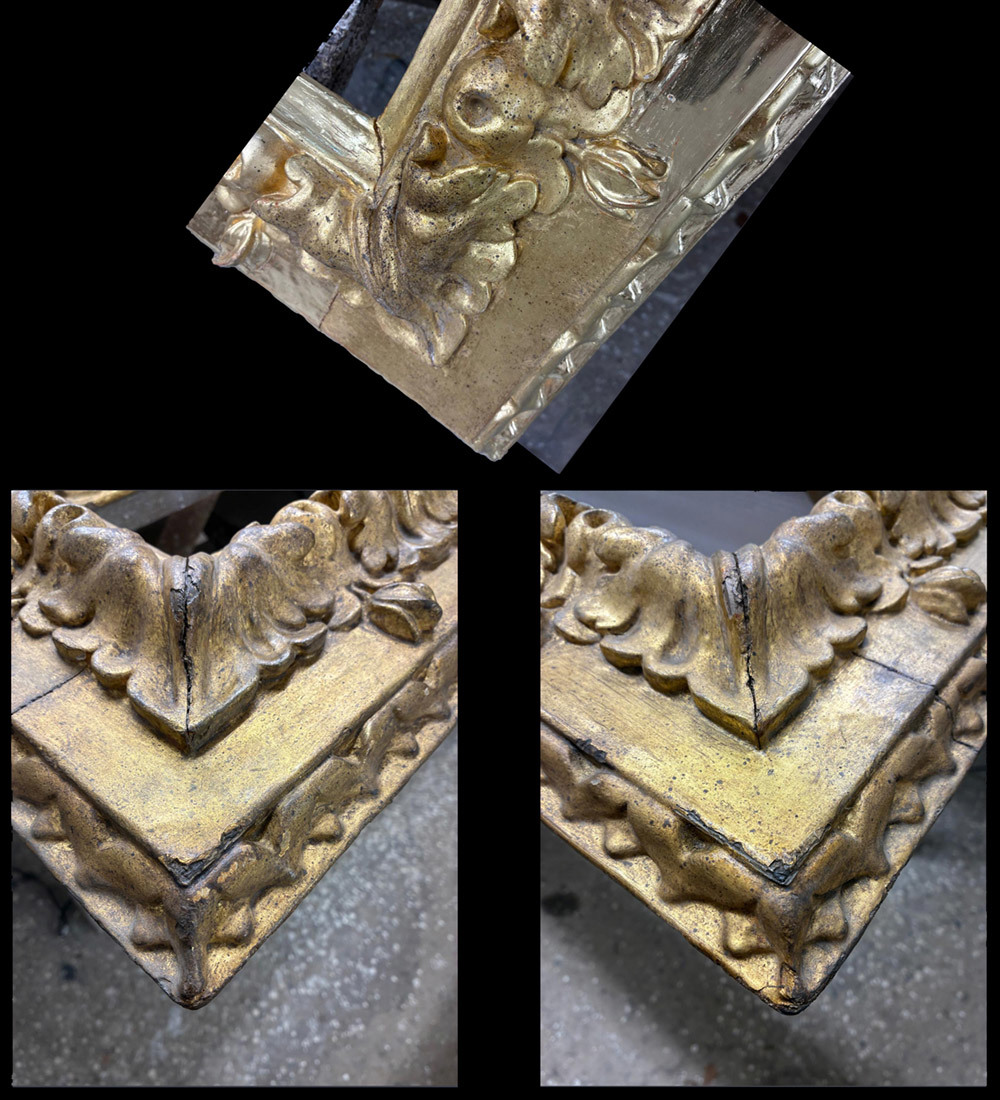
Stages in patinating the gilded frame
However, no-one wants a shiny golden border with brilliant highlights outfacing the painting it holds, and making it impossible to see clearly - particularly not when the painting is an old master, and is also confected of subtly varied shadows and relatively muted light tones. To produce a perfect replica of an antique frame, it is necessary that it should show the same effects of ageing and wear as the original - a finish which has been toned down, distressed and patinated to mirror the surface of the model. This process gives it an appearance of ageing equivalent to that of the painting, since, although the latter may have been expertly cleaned and restored, it will always reveal the period when it was made.
So areas of the frame which would have seen the greatest wear are rubbed back - here and there, even through the gesso to the wood - and the gold is misted and softened with colours or lacquers of various kinds appropriate to the period of the original. This, like the whole process of gilding, is one of time-consuming and meticulous care, where the skill employed is instinctive as much as consciously learnt, and is a rare and invaluable talent. The goal is to produce a twin of the model, such that it is impossible to tell them apart from the front.
When the painting in this frame is compared with its former appearance in the plain gold frame in which it arrived, the possibilities opened by reframing in different contemporary designs become strikingly apparent, and the effects of the interplay between these two parts of a work of art reveal how aware the artist must have been of the choices open to him or her, and to the commissioning client. Here is a rediscovered masterpiece by a great painter, which has regained with this frame both its Baroque context, and the symbolic presentation of the victorious David as a warrior-king.
Categories
- Articles on multiple aspects of European frames
- Recent framing projects undertaken by Paul Mitchell Ltd